
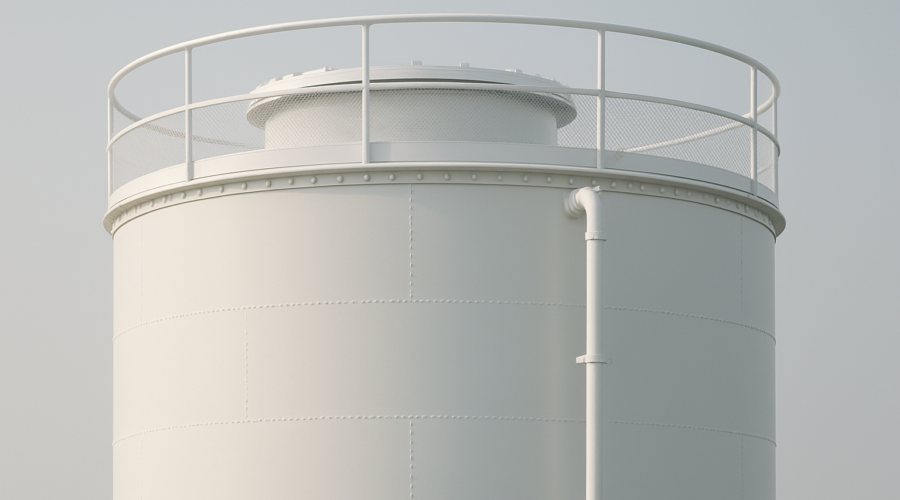
Most storage tanks get attention only when something goes wrong: a weep at a weld seam, a failed inspection, or a vessel that can’t handle the product it was bought for. For facilities that handle crude oil, refined fuels, produced water or process chemicals, the tank is a long-term asset that shapes safety, compliance and operating cost for decades.
That’s why so many operators specify tanks built to American Petroleum Institute (API) standards. These documents give buyers, fabricators and inspectors a shared language for materials, welding, testing and design limits.
A standard doesn’t make the decision for you, though. This guide walks through the questions engineers and facility managers should be able to answer before they ever request a quote.
Start With What the Tank Will Hold
Product chemistry drives nearly every other choice. Sour crude, diesel, ethanol blends and saltwater all behave differently against carbon steel, coatings and gaskets.
Look past the main product to whatever travels with it. Produced water often carries chlorides and hydrogen sulfide, both of which speed up corrosion, so a tank that stores clean fuel for 30 years may degrade far sooner in that service.
Temperature and vapor pressure belong on the same list. A heated asphalt tank or a tank holding volatile light ends needs very different design features than a lube oil tank sitting at ambient conditions.
Know Which API Standard Fits the Job
API 650, Welded Tanks for Oil Storage, covers vertical, cylindrical, aboveground tanks operating at internal pressures up to about 2.5 psig. It’s the standard behind most large tanks at refineries, pipeline terminals and bulk plants.
API 12F applies to smaller shop-welded tanks for production liquids, the kind you see lined up at well pads and tank batteries. Its sibling, API 12B, covers bolted tanks that can be assembled in remote spots where field welding is impractical.
Two more standards round out the picture. API 620 handles larger tanks that run at somewhat higher pressures, while API 653 governs inspection, repair and alteration once a tank is in service, so it pays to know which documents will apply both on delivery day and twenty years later.
Size for Real Operations, Not Nameplate Volume
Nominal capacity and working capacity are not the same number. Usable volume sits between the lowest level your pump can draw from and the highest safe fill level, which has to leave room for overfill protection.
Base the size on throughput, delivery schedules and how often product turns over. A terminal receiving pipeline batches has very different needs than a manufacturing plant that takes two truckloads of fuel a week.
It’s also worth asking whether several smaller tanks beat one large one. With more than one tank, you can take a unit out of service for cleaning or inspection without shutting down the operation.
Decide Between Shop-Built and Field-Erected
Shop-built tanks are fabricated indoors, which usually means more consistent welds and less time on site. Their size is capped by what can legally travel by truck, so they suit modest capacities.
Field-erected tanks are assembled on site from steel plate and can reach enormous volumes. The trade-off is a longer construction window, more foundation engineering and exposure to weather delays.
In practice, the choice often makes itself. An operator bringing a new tank battery online usually favors shop-welded 12F tanks for speed, while a terminal adding 100,000 barrels of storage will almost certainly build in the field.
Weigh Materials, Linings and Corrosion Protection
Carbon steel plate, such as SA-516-70 or SA-283C, remains the default because it’s strong, weldable and economical. Stainless grades like 304L and 316L come into play where corrosion resistance or product purity matters more than first cost.
Coatings and corrosion allowance buy service life. Many owners specify an epoxy lining for water-bearing service and add extra shell and bottom thickness to give inspectors more margin before repairs are needed.
Give the tank bottom special attention, since it sits against soil or a concrete pad where problems stay hidden. Cathodic protection (addressed in API 651) and internal linings (API 652) are often paired to fight bottom-side corrosion, one of the most common sources of leaks.
Plan the Foundation, Fittings and Layout Early
A well-built tank on a poor foundation becomes a problem quickly. Uneven settlement can distort the shell and stress nozzles, so a geotechnical review is money well spent on larger units.
Settle nozzles, manways, gauging, vents and access platforms before fabrication starts. Normal vents must keep up with pumping rates and thermal breathing, emergency vents must relieve pressure during a fire, and changes made after the tank leaves the shop cost far more.
Spacing matters as much as the tank itself. Distances to property lines, buildings and other tanks are set by fire codes such as NFPA 30, and workplaces storing flammable liquids also fall under OSHA’s flammable liquids standard.
Build Environmental Compliance Into the Design
In the United States, aboveground oil storage brings the EPA’s Spill Prevention, Control, and Countermeasure (SPCC) rule into play once a facility’s aggregate aboveground capacity exceeds 1,320 gallons in containers of 55 gallons or more. The EPA’s overview of the SPCC regulation explains who is covered and what a compliant plan requires.
Secondary containment is the requirement most likely to affect your layout. Whether you choose earthen dikes, concrete walls or double-wall tanks changes the site footprint and budget, so make that call during design rather than after delivery.
State agencies and air permits can add further layers. Volatile products may need floating roofs or vapor recovery, which is another reason to involve your environmental team before the drawings are final.
Don’t Overlook Oily Wastewater
Not every API-related tank stores saleable product. Fueling stations, maintenance wash bays, bulk petroleum yards and remediation sites all produce water contaminated with oil that has to be collected and treated before discharge.
The term “API” turns up here too, through the oil-water separator design principles described in API Publication 421. For this kind of service, it makes sense to evaluate aboveground API tanks built for oily wastewater handling rather than adapting a standard product tank, and to confirm with your local utility what the effluent must meet before it reaches the sewer.
Vet the Fabricator as Carefully as the Design
An API tank is only as reliable as the shop that builds it. Ask whether the fabricator is licensed under the API Monogram Program for the specification you need, and request weld procedure qualifications, material test reports and hydrostatic test records.
Range and experience say a lot. Austin-based Tex-Tanks, for example, works with customers in petroleum refining, chemical processing, water treatment and food production, and a builder with that kind of breadth has usually seen more unusual service conditions than a single-market shop.
Finally, ask what happens after delivery. Installation support, commissioning help and maintenance services can matter as much as fabrication quality over the life of the tank.
Budget for the Whole Lifecycle
The purchase price is only a fraction of what a tank will cost you. Inspections, cleaning, coating renewal and eventual repairs add up over a service life that often runs 30 years or more.
Inspection standards set much of that schedule. API 653 governs field-erected tanks, and many owners follow STI SP001 for shop-fabricated units, so designing in good access through manways and cleanouts makes every future inspection cheaper.
Keep the paperwork, too. The data sheet, mill certificates and test records become the baseline every future inspector will compare against.
Bringing It Together
Choosing an API storage tank is really a chain of linked decisions: product, standard, capacity, construction method, materials, site layout, compliance and builder. Get the first few right, and the rest tend to follow.
The best results come when operations, engineering and environmental staff sit at the same table early. Each group sees risks the others miss.
In the end, the right tank is neither the cheapest nor the biggest. It’s the one built for the service it will actually see, on a site prepared to support it for decades.
The Short Version
- Storage tanks for crude oil and refined fuels are long-term assets that significantly influence safety, compliance, and operating costs.
- The tank’s product chemistry is a key factor that affects decisions related to materials, coatings, and design features.
- API standards, including API 650, API 12F, and API 620, provide guidelines for the construction and inspection of different types of storage tanks.
- Nominal capacity differs from usable volume, and it’s crucial to base tank sizing on operational needs rather than just nameplate specifications.
- Shop-built tanks offer consistent quality and faster assembly times, while field-erected tanks can be much larger but take longer to construct.
- Compliance with the EPA’s Spill Prevention, Control, and Countermeasure rule is essential for facilities with significant aboveground storage capacity.